Outdoor patio curtains are weather-resistant fabric panels that hang from a rod, cable, or ceiling track to add shade, privacy, and softness to your patio. Most panels cost $10–$40 each at major home-improvement retailers, hang in an afternoon, and instantly make an open slab feel like a real outdoor room.
Here’s the thing most people get wrong: they shop for outdoor patio curtains the way they’d shop for bedroom drapes — chasing a color match first. Out here, the fabric and the hardware matter more than the print. A panel that can’t handle sun, rain, and a gust of wind will look sad by August, no matter how pretty the pattern. So before we get to the pretty ideas below, remember the formula: weather-rated fabric + sturdy hardware + a little extra fullness. Everything else is just styling.
In this guide, I’ll walk you through 11 ways to style outdoor patio curtains — from airy sheers to wind-proof privacy panels — plus what each option typically costs and how to hang them so they actually stay up.



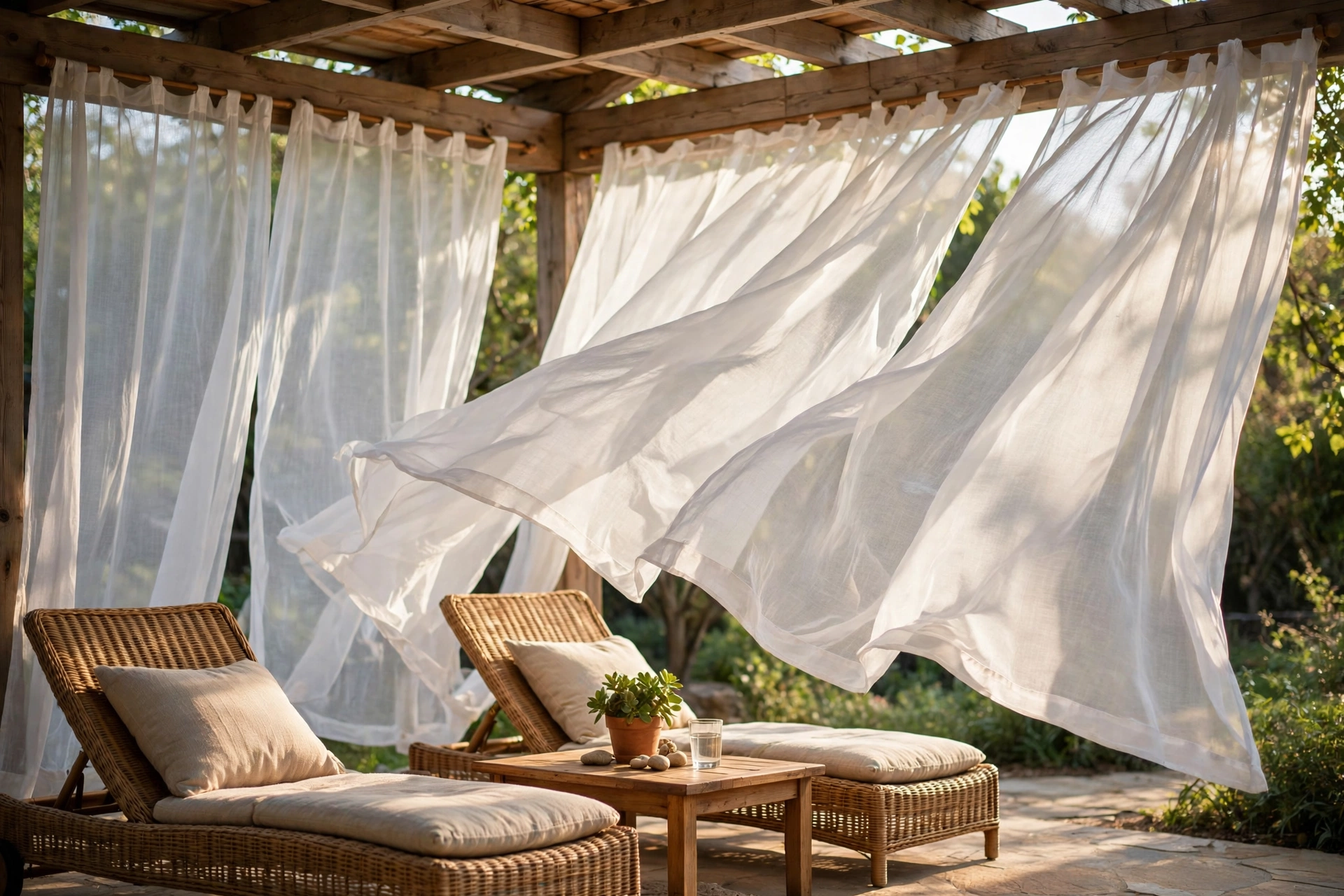
1. Classic White Sheer Outdoor Patio Curtains
If you’re only going to try one look, make it this one. White sheer outdoor patio curtains are the most forgiving choice on the list: they soften harsh afternoon sun without blocking your view, they look good on every style of house from farmhouse to modern, and they’re usually the cheapest panels in the store. Hang them from the front edge of a pergola or covered patio, and the whole space takes on that breezy, resort-cabana feeling for the price of a pizza night.
The trick with sheers is fullness. Because the fabric is thin, you need more of it — aim for panels that total 1.5 to 2 times the width of the opening you’re covering. Sheers also show dirt faster than darker fabrics, so look for machine-washable polyester or olefin panels. Most standard sheer panels (54″ x 84″) run about $12–$25 each at major retailers, so curtaining a 10-foot opening typically costs under $100 in panels alone.
2. Waterproof Canvas Panels for Rainy Climates
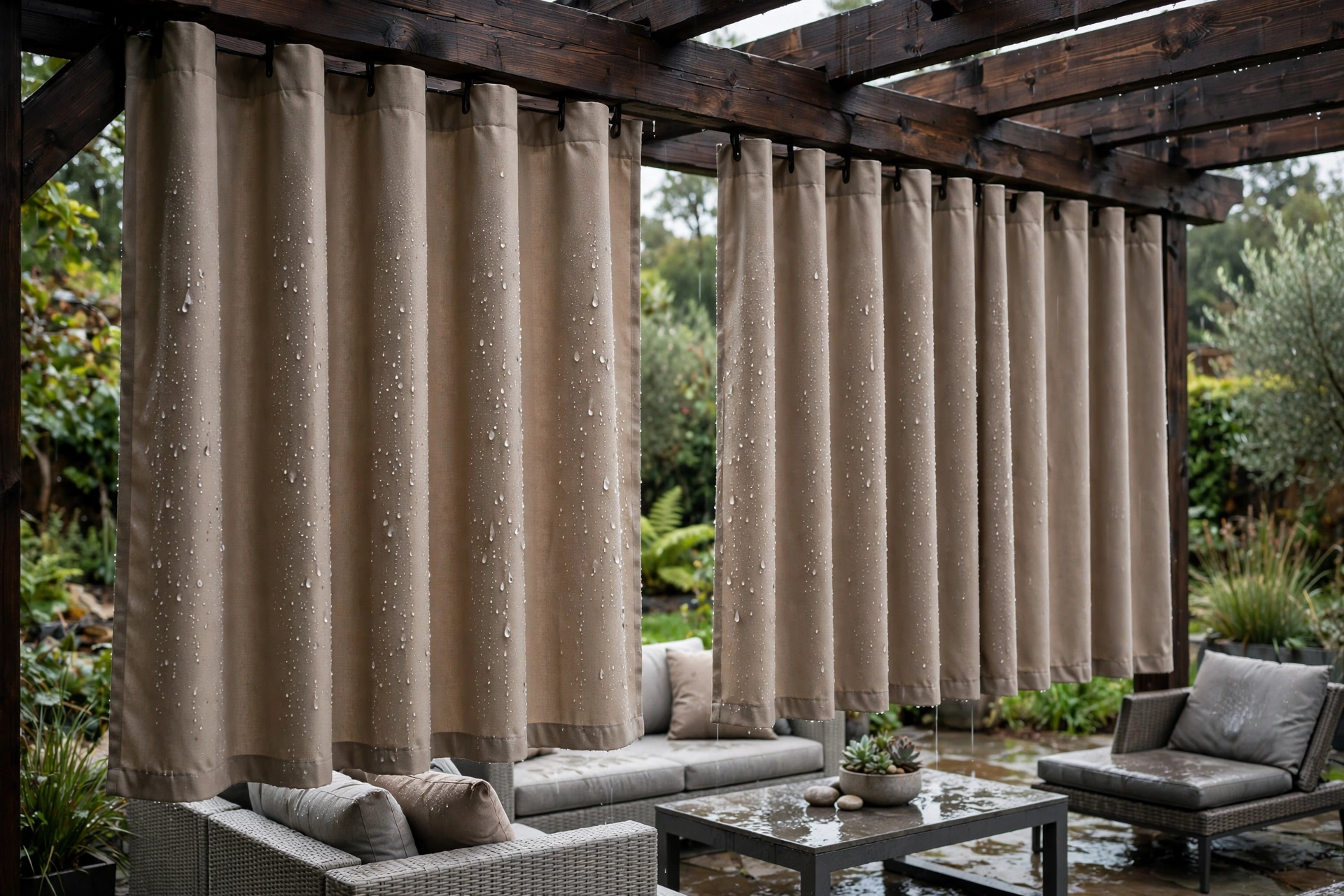
Sheers are lovely, but if your patio gets real rain — not just morning dew — you’ll want waterproof or water-resistant canvas panels. These are woven from solution-dyed acrylic or polyester with a water-repellent finish, so rain beads up and rolls off instead of soaking in. They’re also heavier, which means they hang straighter in a breeze and give you noticeably more privacy than sheers.
The trade-off is airflow: canvas panels block more breeze along with more rain, so on hot days you’ll want to tie them back. Look for panels labeled “fade resistant” or “UV resistant” — cheaper waterproof curtains can lose their color in a single summer of direct sun. Expect to pay $20–$40 per panel for good canvas options, and check the corners: reinforced grommets and double-stitched hems are the details that separate a one-season curtain from a five-season one.
3. Blackout Privacy Panels for Close Neighbors
When the house next door can see straight onto your patio, blackout outdoor curtains are the fastest privacy fix that doesn’t involve a fence. These panels have a light-blocking backing (usually a triple-weave construction) that turns your patio edge into a soft, solid wall. Draw them closed for a private dinner, open them wide when you want the view back — it’s the flexibility a fixed screen can’t give you.
Blackout outdoor panels are also surprisingly good at cutting glare on a west-facing patio, which makes evening screen time or outdoor movie nights much more pleasant. They do hold heat, so in very hot climates choose a light color to reflect sun rather than absorb it. A typical pair of 52″ x 84″ blackout outdoor panels costs $25–$45, and for privacy coverage, mount them so they overlap by a few inches when closed — even a small gap defeats the purpose.
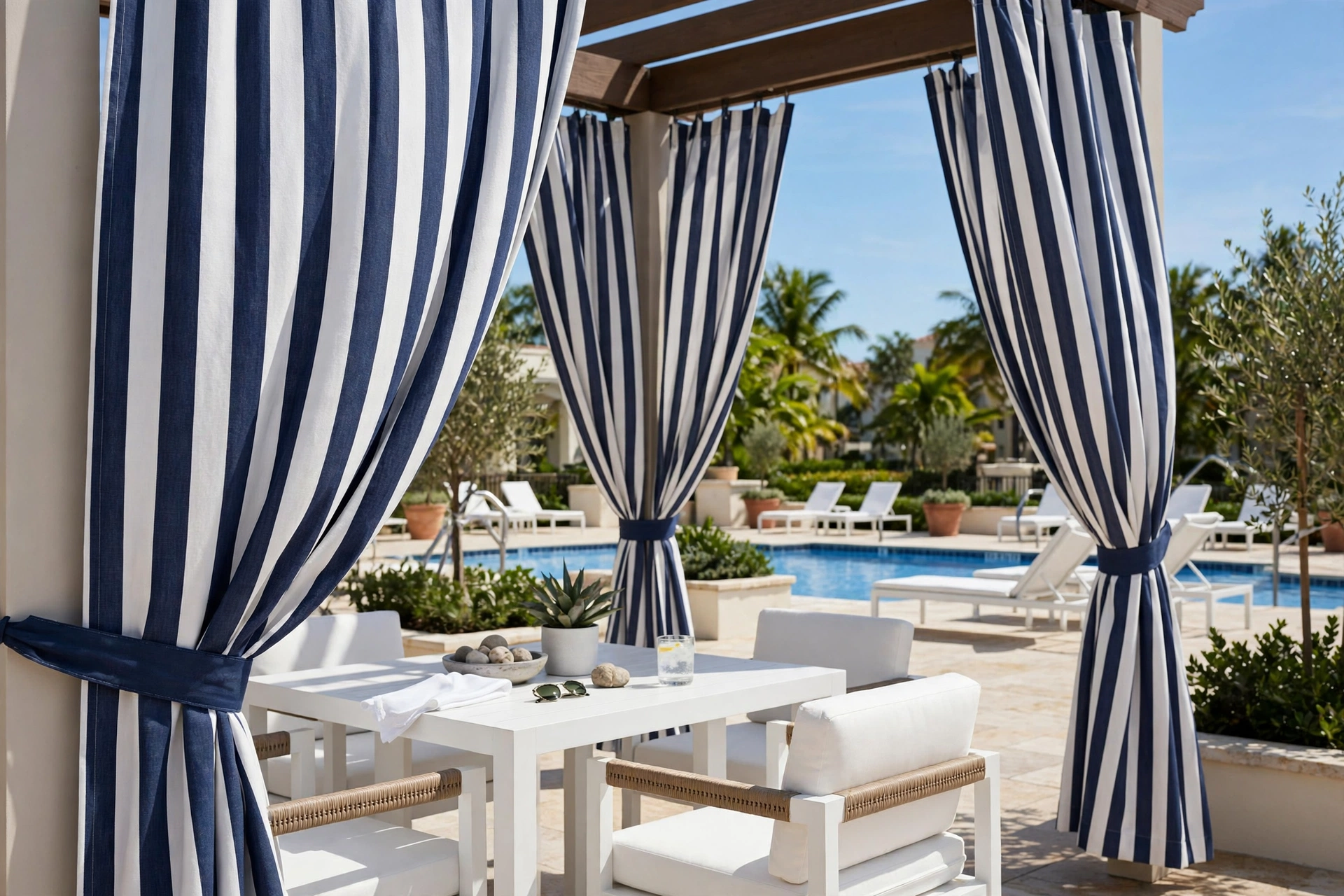
4. Striped Cabana Curtains for a Resort Look
Nothing says “vacation” like bold cabana stripes. Wide navy-and-white or green-and-white stripes give a plain patio the instant polish of a boutique hotel pool deck, and because the pattern is doing the visual work, you can keep the rest of your furniture simple. Striped panels photograph beautifully too, if you care about that sort of thing.
One honest caveat: printed stripes fade faster than solid solution-dyed fabrics, because the color sits on the surface rather than running through the yarn. If your patio gets brutal afternoon sun, look for stripes in solution-dyed acrylic (Sunbrella-type fabrics) rather than printed polyester. You’ll pay more — $30–$60 per panel — but the stripes will still look crisp in year three. On a shaded or north-facing patio, printed stripes at $15–$25 a panel hold up just fine.
Prices reviewed: October 2026
| Curtain Type | Typical Cost per Panel | Best For | Watch Out For |
|---|---|---|---|
| Sheer polyester/olefin | $10–$25 | Soft light, airy feel | Shows dirt; minimal privacy |
| Waterproof canvas | $20–$40 | Rain, wind, year-round use | Blocks breeze; heavier hardware needed |
| Blackout / privacy | $25–$45 | Close neighbors, glare control | Holds heat in dark colors |
| Striped cabana | $15–$60 | Resort style, visual impact | Printed stripes fade in harsh sun |
| Linen-look textured | $20–$35 | Relaxed boho texture | Snags; usually needs lining |
Cost ranges above are estimates based on typical 2026 pricing from major home-improvement retailers and online home stores.
5. Linen-Look Boho Drapes for a Relaxed Vibe
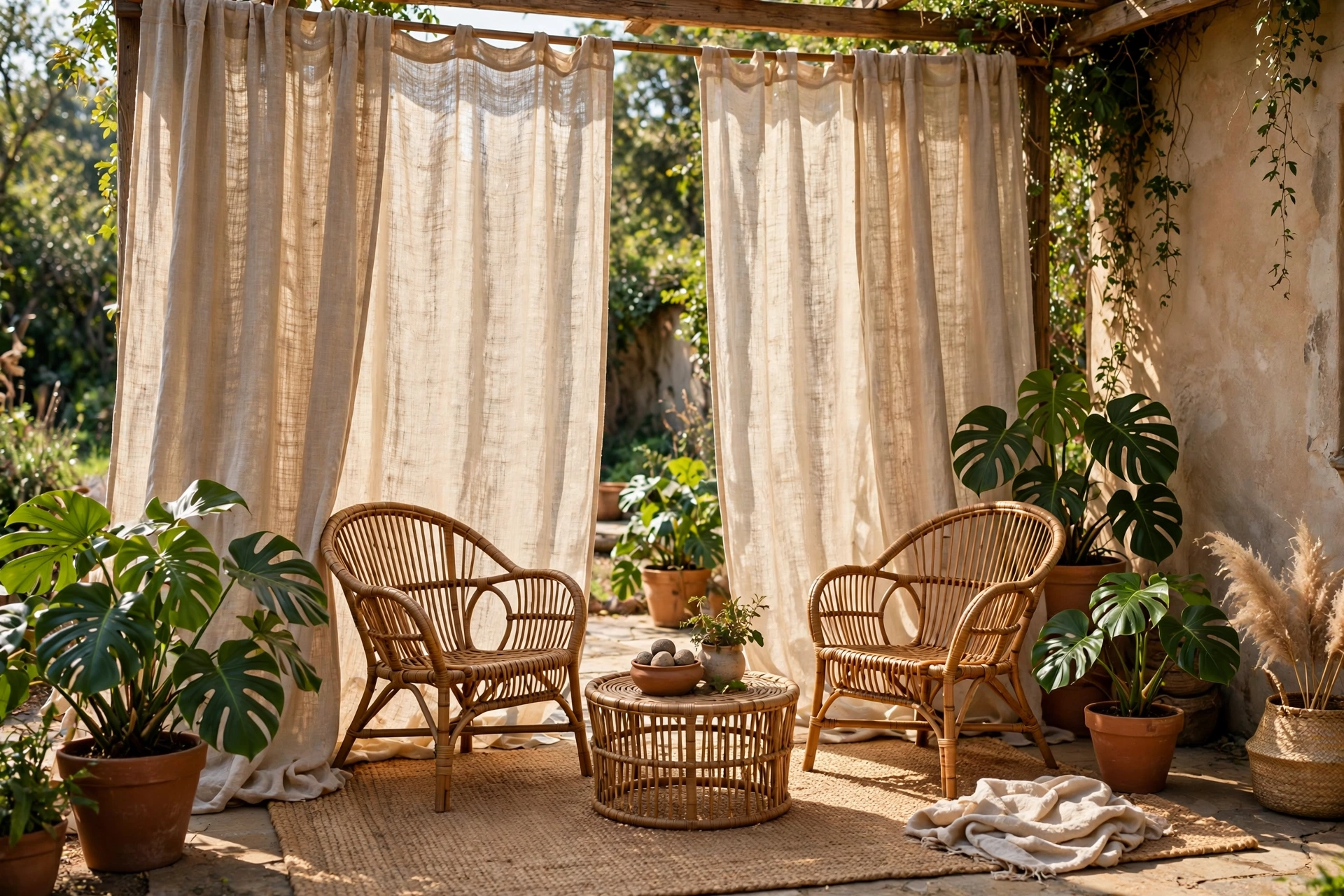
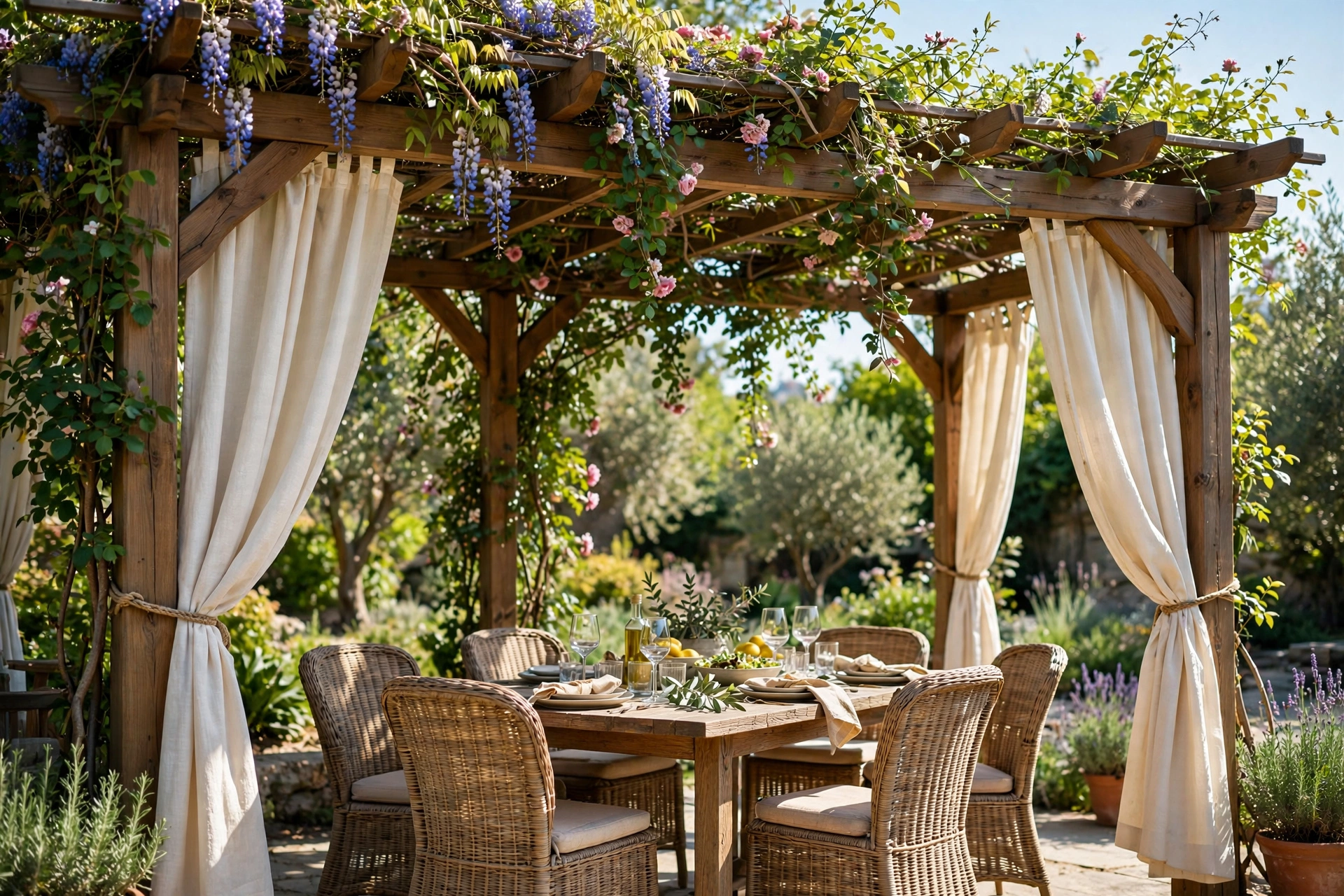
If your patio style leans natural — rattan chairs, jute rug, lots of plants — linen-look outdoor curtains are your match. These panels have a slubby, textured weave that reads as relaxed and organic rather than crisp and tailored. In warm neutrals like oatmeal, sand, or clay, they blend with wood and greenery instead of competing with it.
Real linen isn’t ideal outdoors (it mildews and fades), so look for “linen-look” polyester or olefin that mimics the texture with weatherproof fibers. The loose weave also means these curtains filter light beautifully — dappled shade rather than a hard block. They snag more easily than smooth canvas, so hang them away from thorny plants and rough wood edges. Plan on $20–$35 per panel, and give them an extra steam or shake when you hang them; the texture looks best with a little natural wrinkle.
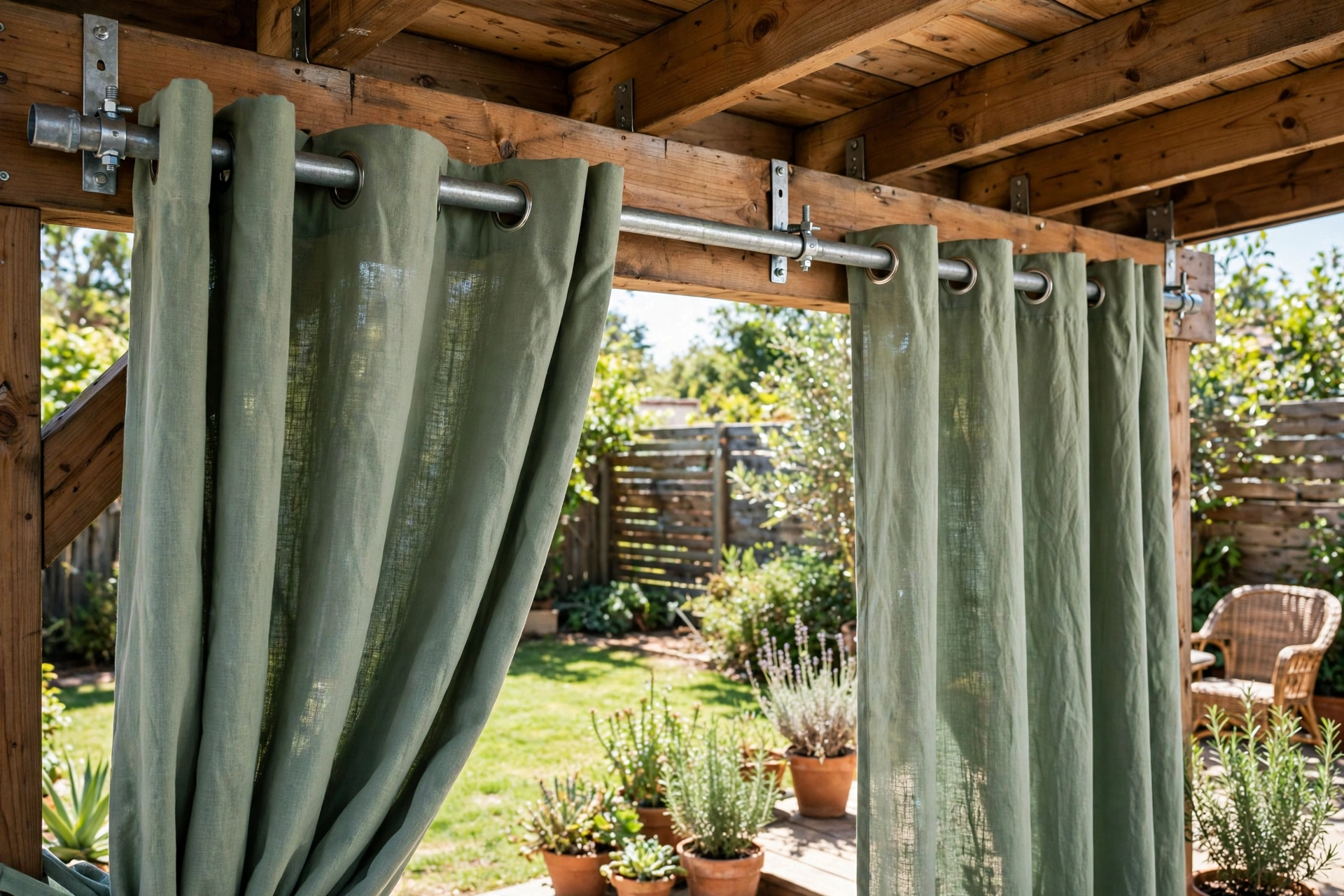
6. Grommet-Top Curtains on a DIY Conduit Rod
Here’s the budget hanging hack: skip the $40-per-foot “outdoor curtain rod” and buy electrical conduit from the hardware store instead. A 10-foot length of 3/4-inch EMT conduit costs a few dollars, it’s galvanized against rust, and it slides perfectly through standard curtain grommets. Mount it with conduit straps or eye hooks, and you have a rock-solid rod for the price of a coffee.
Grommet-top panels are the best match for this setup because they slide smoothly and the metal grommets won’t rust the way cheap plastic rings can. Measure your opening, add 4–6 inches on each side for the mounts, and use a pipe cutter or hacksaw to trim the conduit. This is also the easiest way to curtain a long span — conduit comes in 10-foot lengths you can couple together. Total hardware cost for a 10-foot run: typically under $15, which leaves more of your budget for the actual outdoor patio curtains.
7. Wire Cable Curtain Track for a Clean Minimal Line
If conduit feels too industrial for your taste, a stainless-steel wire cable system gives you an almost invisible hanging line. Two turnbuckles, a length of cable, and some curtain rings with clips — that’s the whole kit. The cable disappears against the sky, so your curtains look like they’re floating, and it’s the best option for curved or angled pergola edges where a straight rod won’t work.
Tension is everything with cable systems: pull it drum-tight or the middle will sag under the weight of wet fabric. Use marine-grade 316 stainless cable and hardware so nothing rusts, and anchor into solid wood or masonry — not fascia boards. A 16-foot cable kit typically runs $25–$50, and clip rings let you hang any flat panel, so you’re not limited to grommet tops. For more privacy structure ideas to pair with curtains, see our guide to patio privacy ideas with screens and plants.
8. Curtains Layered With String Lights
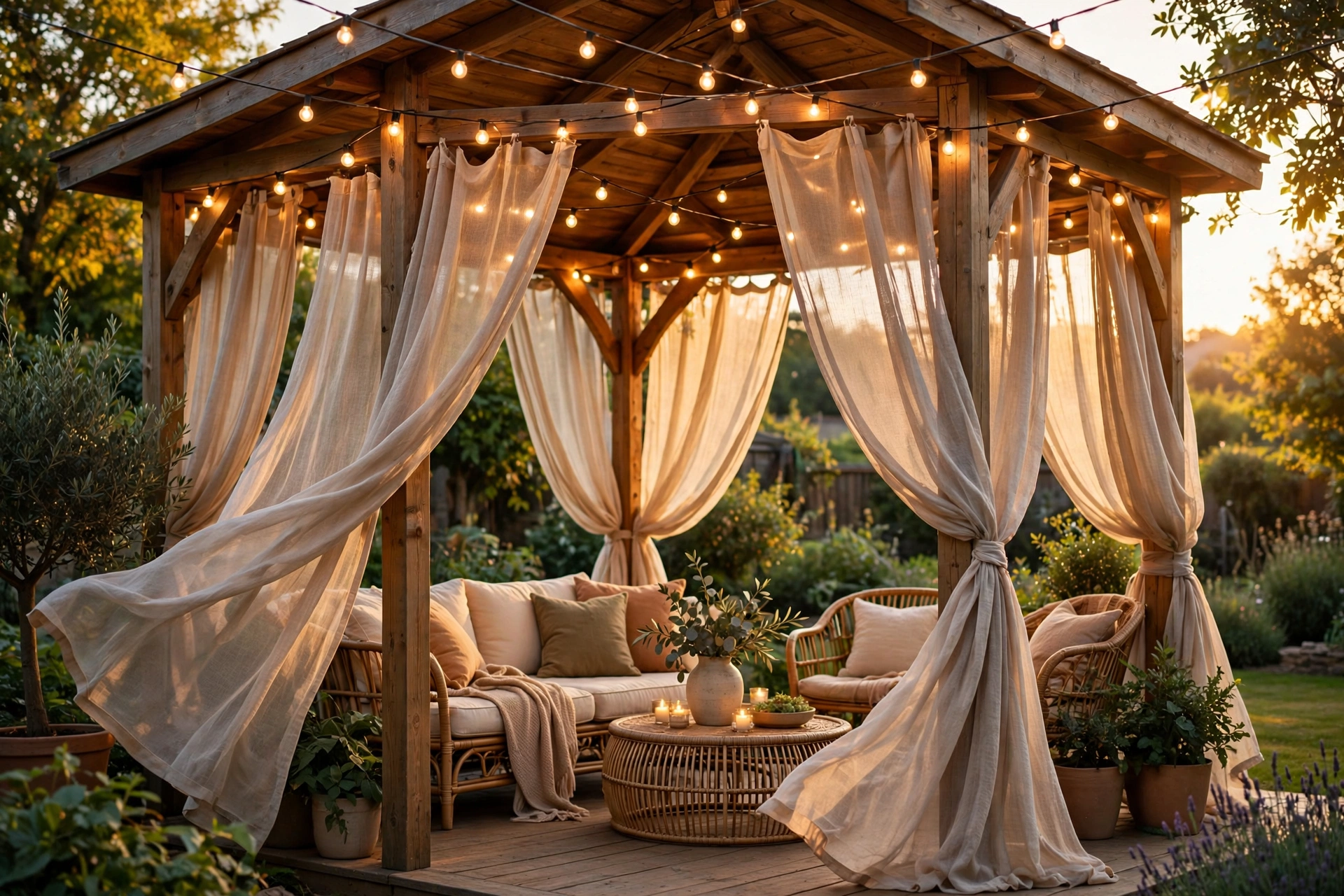
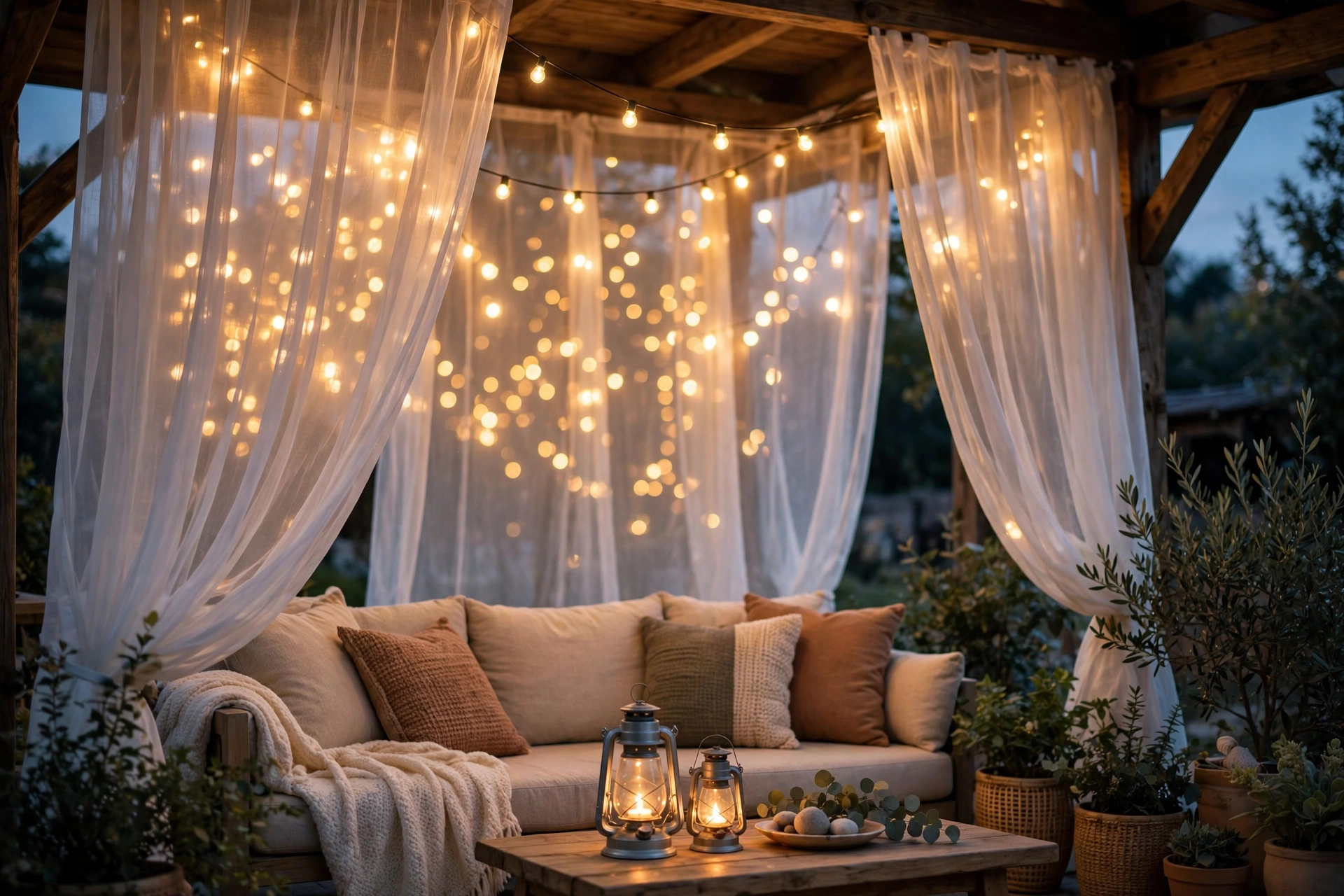
This is my favorite trick for evening ambiance: hang your outdoor patio curtains first, then drape patio string lights in a loose swag just inside or behind them. When the lights glow through sheer or linen-look fabric, you get a soft, diffused glow that no bare bulb can match — the curtain becomes a giant lampshade. It’s the difference between “lights on a patio” and “an evening you’d plan a dinner party around.”
A few practical notes: keep plug-in light strands away from water pooling at curtain hems, and use outdoor-rated lights with shatterproof bulbs. Solar string lights work beautifully here too since there’s no cord to manage, though they’re dimmer. Hang the lights on a separate line (or the same cable system as idea 7) so you can open the curtains without dragging the lights along. Total cost for the lighting layer: often $15–$30 for a couple of solar strands.
9. Tie-Back Curtains That Frame a View
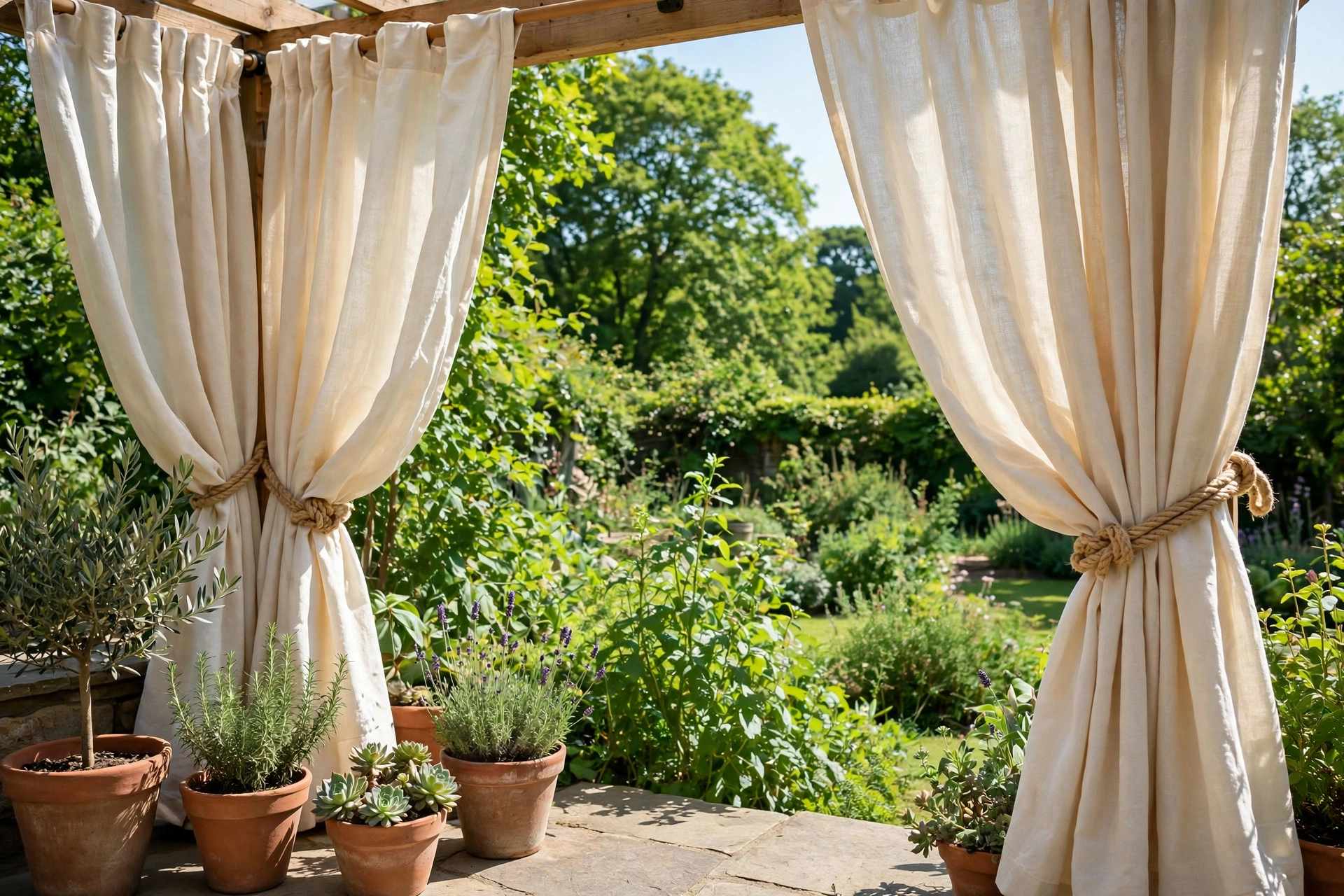
Sometimes the best curtain is one you barely close. Tie-backs turn your panels into soft columns that frame your view — the garden, the pool, the sunset — instead of hiding it. This works especially well when your patio’s best feature is what’s beyond it, and it keeps fabric out of the way on windy days when loose panels would flap and tangle.
You can buy outdoor tie-backs with magnetic or Velcro closures for $8–$15 a pair, or make your own from marine rope for a nautical look. Position the tie-back at about two-thirds height for a classic drape, or lower for a more modern, gathered look. And here’s a maintenance bonus: tied-back curtains stay cleaner and drier than panels left hanging loose, because air circulates around them and rain runs off instead of pooling in the folds.
10. Weighted-Hem Curtains That Survive Wind
Wind is the number-one killer of outdoor curtain setups. If your patio catches gusts, look for panels with weighted hems — or add your own weights. Many outdoor-specific panels come with small weights or wind-grommets sewn into the bottom corners; if yours don’t, drapery chain weights or even fishing sinkers sewn into a hem pocket work just as well.
Weights do two things: they keep the panel hanging straight so it looks tailored instead of tangled, and they stop the bottom edge from whipping around and shredding the fabric. Pair weighted hems with a bottom tie-down system (small bungee cords or snap straps to the deck or railing) on truly exposed patios. This is also where fabric weight matters — heavier canvas panels like idea 2 handle wind far better than sheers, so match your fabric to your exposure. If wind is a constant battle on your patio, our patio wind protection ideas cover screens, barriers, and plantings that help.
11. Seasonal Swap: Dark Panels for Fall and Winter
Who says curtains are only a summer thing? Swapping light sheers for richer panels in fall — deep olive, warm rust, charcoal — extends your patio season visually even when the temperatures drop. Darker fabrics also absorb a little more solar warmth on sunny autumn days, which is a small but real comfort gain.
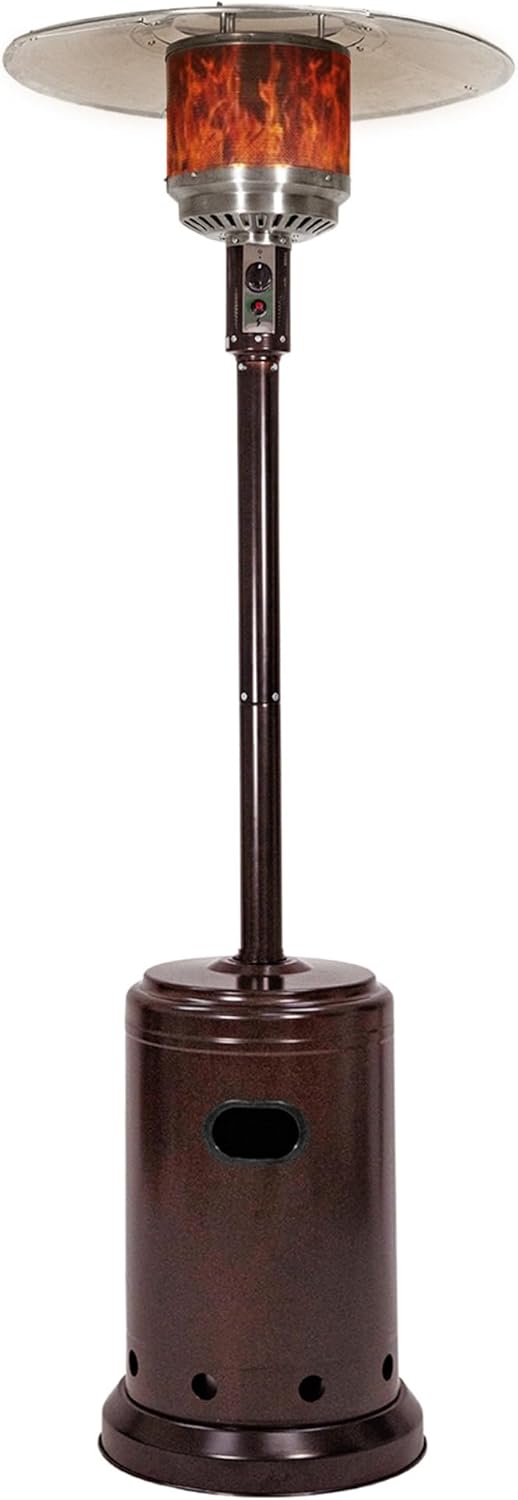
The practical version of this idea: buy one set of summer sheers and one set of heavier fall panels, and store the off-season set in a deck box or vacuum bag. Two sets of budget panels ($60–$100 total for both) cost less than one “premium” set and give you a fresh look twice a year. When you transition the space for colder months, pair the darker curtains with your patio heater ideas for winter — curtains plus a heater turn a chilly patio into a genuine three-season room. For the full seasonal playbook, see winter patio transition ideas.
Frequently Asked Questions
Can you leave outdoor patio curtains up all year?
In mild climates, yes — quality solution-dyed acrylic or olefin panels can stay up year-round. In areas with heavy snow, ice, or months of driving rain, take them down for the worst of winter to extend their life. Either way, take curtains down before any major storm you wouldn’t leave a patio umbrella open through.
What is the best fabric for outdoor patio curtains?
Solution-dyed acrylic (like Sunbrella-type fabrics) is the gold standard: the color runs through the fiber, so it resists fading for years. Olefin and polyester outdoor fabrics are good budget alternatives. Avoid indoor-only fabrics and real linen outdoors — they’ll fade, mildew, or rot within a season or two.
How do I keep outdoor curtains from blowing in the wind?
Choose heavier fabrics or panels with weighted hems, mount your rod or cable drum-tight, and add bottom tie-downs like bungee cords or snap straps on exposed patios. Tie-backs also work: gather the panels when gusts pick up instead of letting them fly.
How many curtain panels do I need for my patio?
Measure your opening, then multiply by 1.5 to 2 for fullness — a 10-foot opening needs 15–20 feet of panel width. Most panels are 50–54 inches wide, so plan on 4–5 panels for a 10-foot span with sheers, or 3–4 with heavier fabrics.
Can I use indoor curtains outside?
For a covered, fully dry spot and a single season, you can get away with it — but indoor fabrics will fade fast in sun and mildew in humidity. Outdoor-rated panels cost about the same as mid-range indoor curtains and last dramatically longer, so it’s rarely worth the shortcut.

Key Takeaways
- Outdoor patio curtains cost roughly $10–$40 per panel — a 10-foot opening typically needs 4–5 panels, so most projects land under $200.
- Match the fabric to your exposure: sheers for shade and style, waterproof canvas for rain, blackout panels for privacy.
- Sturdy hardware (conduit rods, tensioned cable, or ceiling tracks) matters more than the curtain price for long-term success.
- Weighted hems and tie-backs are the simplest fixes for wind, the biggest enemy of outdoor curtains.
- Pair curtains with string lights or a patio heater to stretch your patio’s usable season.