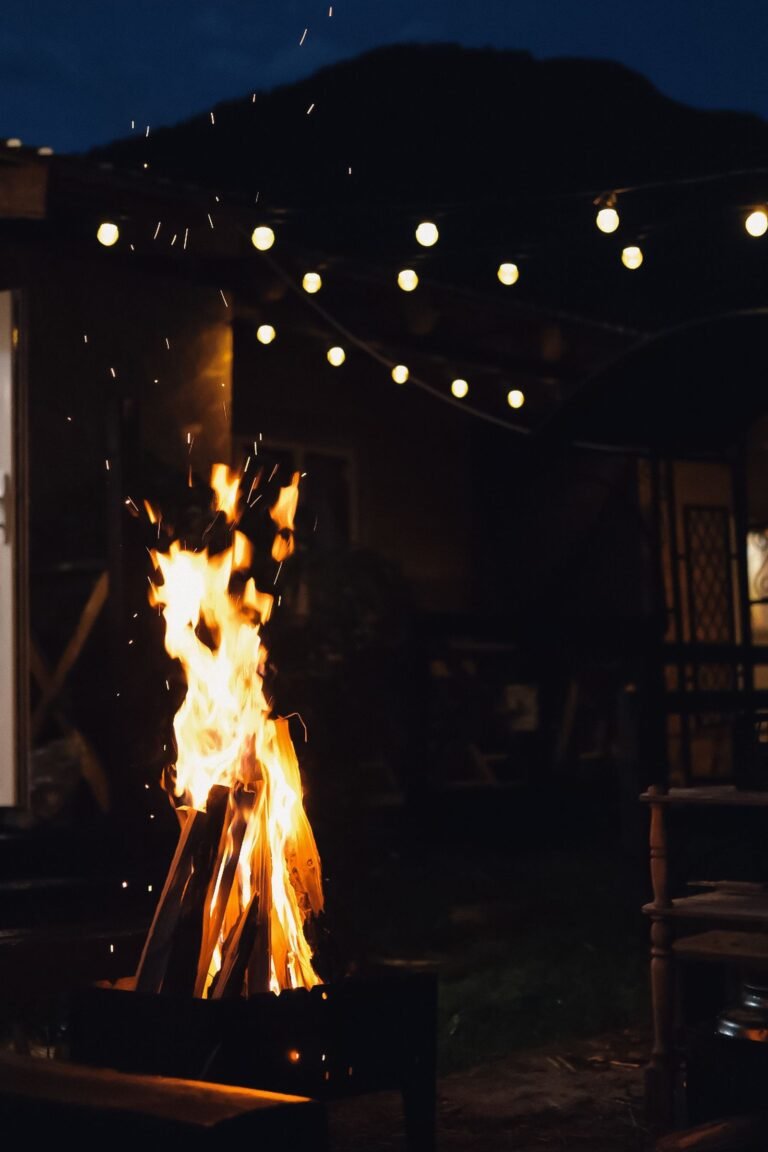
A dark porch after sunset is a missed opportunity — and honestly, a little unwelcoming.
Good front porch lighting does three jobs: it welcomes guests, deters trouble, and makes your home look incredible from the street. The secret is layers — no single fixture does it all. Here are 16 ideas covering every layer.
Overhead Lights
1. The Classic Flush Mount
One well-chosen ceiling fixture anchors a covered porch. Go bigger than you think — undersized fixtures are the most common porch lighting mistake. For an 8-foot ceiling, a 12-15″ fixture feels right.




Best for: Covered porches needing general illumination.
2. Hanging Pendant (Porch Chandelier)
A pendant or mini-chandelier hung at 7 feet above the floor adds drama and a focal point. Outdoor-rated woven, metal, or seeded-glass pendants all work. This is the jewelry of the porch.
Best for: Making a design statement; porches with 9+ foot ceilings.
3. Recessed Ceiling Lights
Clean, modern, invisible by day. Space them 4-6 feet apart for even coverage. Best installed during construction or renovation, but retrofit kits exist for accessible attics.
Best for: Minimalist porches where fixtures would clutter.
Wall Lights (Sconces)
4. Flanking Sconces
One lantern-style sconce on each side of the front door — the timeless formula. Mount them at eye level (66″ from floor to center) and at least 6″ from the door frame.
Best for: The can’t-miss classic that suits every house style.
5. Single Statement Sconce
Asymmetric? One oversized sconce beside the door (on the handle side) looks intentional and modern. Go 1/3 the height of the door for proper scale.
Best for: Modern homes and narrow entries where pairs won’t fit.
6. Gooseneck Barn Lights
That farmhouse-industrial look — a gooseneck arm throwing light down over the door or garage. Black or galvanized finishes, and they look great on brick.
Best for: Farmhouse, cottage, and industrial-style homes.
7. Motion-Sensor Sconces
Security that doesn’t look like security. Modern motion sconces blend with regular fixtures but snap to full brightness when someone approaches.
Best for: Side doors and dark corners where you want awareness without floodlights.
Accent & Decorative
8. String Lights Overhead
Drape warm-white string lights across the porch ceiling or along beams. The single fastest way to make any porch feel magical. Choose LED (they last years, not months).
Best for: Instant ambiance on any budget — under $25 transforms the space.
9. Lantern Clusters
Group 2-3 lanterns (candle or LED) on the floor, a side table, or steps. Vary the heights. This is decor that happens to be lighting — or lighting that happens to be decor.
Best for: Renters and anyone avoiding wiring.
10. Fairy Lights in Planters
Weave micro fairy lights through porch planters or a wreath. Subtle, enchanting, and solar versions need zero effort.
Best for: That “how is this so charming” detail guests notice.
11. Step Lights
Low-voltage lights recessed into risers or mounted on step sides. They prevent trips and look incredibly polished. Solar puck versions exist for retrofits.
Best for: Porches with 3+ steps — safety meets style.
12. Post Cap Lights
If you have porch posts or railing posts, cap lights turn structure into lighting. Solar versions pop right on — no wiring.
Best for: Defining the porch perimeter after dark.
Landscape & Path
13. Path Lights to the Door
Line the walkway with low path lights, staggered (not soldier-straight rows) every 6-8 feet. Warm white (2700K) — never cool blue, which reads institutional.
Best for: Guiding guests in and boosting curb appeal from the street.
14. Uplighting the Facade
One or two well-placed spotlights washing the house facade or a feature tree creates depth and drama. This is what makes homes look expensive at night.
Best for: The “wow” factor visible from the curb.
15. Smart Bulbs Everywhere
Put smart bulbs in your existing fixtures and suddenly you have dimming, scheduling, color temperature control, and vacation mode — no new fixtures needed. Set the porch to warm dim at 10pm automatically.
Best for: Maximum upgrade with zero installation.
16. The Layered Combo (Putting It Together)
The pro formula: one overhead or pendant (general) + flanking sconces (task/accent) + one decorative layer (string lights or lanterns) + path lights (landscape). Four layers, each on its own switch or smart control. That’s the whole secret.
Best for: Anyone who wants the magazine-cover porch at night.
Choosing Bulb Color Temperature
This matters more than fixture style: 2700K warm white for porches, always. 3000K is acceptable. Anything 4000K+ (cool/daylight) makes a porch feel like a parking lot. Check the bulb box before buying.
Best for: Avoiding the #1 lighting regret.
Porch Lighting by House Style
Colonial/Traditional: Flanking carriage lanterns, symmetrical everything, warm white. Brass or black finishes.
Farmhouse: Gooseneck barn lights, seeded glass pendants, Edison-style LED bulbs for that vintage filament look.
Modern: Recessed cans, single linear sconce, minimalist path bollards. Keep it architectural.
Cottage: Hanging lantern pendant, mismatched vintage-style sconces, fairy lights in planters. Charm over symmetry.
Ranch: Flush-mount ceiling fixture + flanking sconces + path lights. Straightforward and welcoming.
Best for: Matching fixtures to your home instead of fighting it.
Smart Controls Worth Having
- Dusk-to-dawn photocell — the set-and-forget basic; lights on at sunset, off at sunrise
- Motion + photocell combo — dim all night, full bright on motion; best of both worlds
- Smart scheduling — porch bright at dinner time, dim after 11pm, off at dawn
- Vacation mode — randomized on/off patterns while you’re away
Most of these are a $15-25 add-on per fixture, not a rewiring project.
Best for: Convenience and energy savings without thinking about it.
When to Call an Electrician
DIY-friendly: swapping fixtures on existing boxes, solar lights, plug-in string lights, smart bulbs. Call a pro for: new circuits, anything inside the main panel, trenching for landscape wiring, or if your wiring is old knob-and-tube. A pro install for two sconces typically runs $150-300 — worth it for safety and code compliance.
FAQ
How bright should front porch lights be?
800-1,200 lumens total for a standard porch is plenty. Brighter isn’t better — glare is the enemy. Multiple softer sources beat one blinding one.
Should porch lights be on all night?
Dusk-to-dawn on a photocell or smart schedule is ideal for security and welcome. All-night full brightness wastes energy; use dim scheduling after midnight.
What’s the best color temperature for porch lights?
2700K (warm white). It flatters skin tones, feels welcoming, and matches candlelight ambiance. Avoid cool white outdoors.
Are solar porch lights bright enough?
For accent and path lighting, yes — modern solar is surprisingly good. For primary door-area illumination where you need to see faces and keys, hardwired is still better.
Related Ideas
- For sconce styles specifically: outdoor wall lantern ideas.
- Lighting your walkway too? See solar path light ideas.
For fixture safety ratings explained, Energy.gov’s outdoor lighting guide is the authoritative reference.