This post contains affiliate links. If you buy through them, we may earn a commission at no extra cost to you.
🔑 Key Takeaways
- The commonly cited rule of thumb: about 10 lbs of base weight per foot of umbrella diameter (a 9 ft umbrella ≈ 90 lbs).
- Cantilever (offset) umbrellas need roughly double — their sideways leverage multiplies wind force.
- Base weight is the floor, not the ceiling: wind, umbrella height, and canopy fabric all push the requirement up.
- Fillable bases (water/sand) are the renter-friendly pick; granite and steel are the set-and-forget picks.
- No base makes an umbrella storm-proof — close it when winds pick up, every time.
I’ll never forget watching my neighbor’s brand-new 10-foot umbrella cartwheel across our courtyard during a surprise gust — base and all. The base weighed 35 pounds. The umbrella needed roughly 100. That $200 umbrella survived; the lesson was free: an undersized base isn’t a minor detail, it’s the whole game. Everything below comes from that day forward — measuring, weighing, and respecting the wind.
How heavy should a patio umbrella base be? It’s the question everyone asks after the first close call, and the answer is more specific than most guides admit. Below: the weight chart by umbrella size, why cantilever umbrellas play by different rules, and the wind-safety habits that matter more than any
number. If you’re planning the shaded setup around it, our covered patio
ideas for small backyards show how umbrellas fit the bigger picture, and This
Old House covers the DIY side of outdoor structures well.
Why Base Weight Matters (The 30-Second Physics)
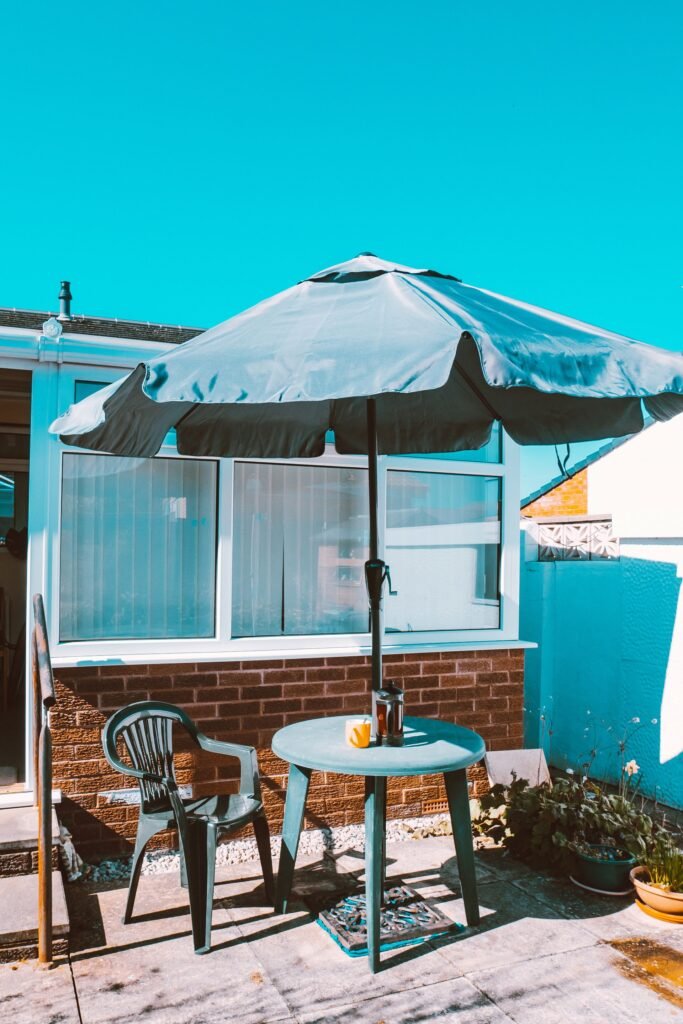
A patio umbrella is a sail on a stick. Wind hitting the canopy creates leverage, and the longer the lever (taller pole, wider canopy, offset arm), the more force at the base. The base’s job is simple: weigh more than the wind’s leverage. Get it wrong and the umbrella becomes a projectile — dangerous to people, pets, and patio furniture. Get it right and you stop thinking about it entirely.
Three things multiply the force your base must resist: canopy size, mounting style (center pole vs. cantilever), and wind exposure. The chart below accounts for the first two; the wind section covers the third.
Rule 1. Start With the 10-Lb-Per-Foot Rule
Best for: standard center-pole umbrellas | the baseline everyone cites
The most commonly cited guideline in the industry: allow roughly 10 pounds of base weight per foot of umbrella diameter. A 7.5 ft umbrella wants ~75 lbs; a 9 ft umbrella wants ~90 lbs; an 11 ft umbrella wants ~110 lbs. Treat this as the minimum for calm, sheltered patios — not the target for windy or exposed spots. Your umbrella manufacturer’s spec sheet overrides this rule every time; check it first.
Search for: “patio umbrella base weight chart by size”
Rule 2. Cantilever Umbrellas Need Roughly Double
Best for: offset/side-post umbrellas | the leverage multiplier
A cantilever umbrella hangs its canopy off to one side of the pole, which massively increases leverage — the wind isn’t just pushing up, it’s twisting. Common guidance: cantilever bases should run roughly double the center-pole equivalent, so a 10 ft cantilever often needs 150–200+ lbs of base (many ship with cross-base frames designed for sandbags or pavers on top). If your cantilever wobbles in a breeze with the stock base, it’s under-weighted — add ballast before the next gust decides for you.
Search for: “cantilever umbrella base weight sandbags”

💡 PRO TIP
Weigh your base, don’t trust the label. Fillable bases are often sold by “capacity” (gallons), not weight — and a “50 lb” base might mean 50 lbs only when filled with sand (water is lighter). Fill it, put it on a bathroom scale, and write the real number on the bottom with a marker.
Rule 3. Know Your Umbrella’s Actual Size
Best for: anyone buying a base separately | measure first
Umbrella “size” means canopy diameter for round umbrellas and diagonal span for square/rectangular ones — an “11 ft” rectangular umbrella can have more sail area than a round one. Bigger canopy = more wind load = heavier base. When in doubt between two base weights, buy the heavier one; nobody ever regretted an over-weighted base, but plenty of people have chased an under-weighted umbrella down the street. So how heavy should a patio umbrella base be for a rectangular model? Start with the diagonal span, then round up — more sail area means more wind load.
📌 You’ll Also Love This
Covered Patio Ideas for Small Backyards
Planning shade for the whole space? See how umbrellas, sails, and pergolas compare for small yards. →
Rule 4. Pick the Right Base Material for Your Life
Best for: renters vs. homeowners | each has a winner
- Fillable resin (water/sand): the renter pick. Ships light, fills to 50–100+ lbs on site, empties for moving day. Sand weighs ~50% more than water per gallon — always choose sand if you can.
- Granite/stone: the set-and-forget pick. Dense, handsome, and heavy (often 70–110 lbs in a compact footprint). You won’t move it twice.
- Steel: slim profile, very heavy for its size, rust-resistant coatings matter. Great under dining tables where footprint counts.
- Concrete: cheapest per pound, ugliest per pound. Fine if it’s hidden; paint it if it’s not.
Search for: “fillable patio umbrella base sand vs water weight”

Rule 5. Factor In Wind, Not Just Size
Best for: exposed patios, high-rises, coastal areas | the multiplier
The chart below assumes a sheltered patio. Add weight for exposure: open yards, rooftops, and coastal spots routinely see gusts double the forecast. A common-sense adjustment used by installers: add 25–50% more base weight for moderately windy sites, and consider giving up on umbrellas entirely for truly exposed rooftops (a shade sail handles wind far better). Your local wind reality beats any chart. That’s why how heavy should a patio umbrella base be depends as much on your site’s gust profile as on the umbrella’s diameter.
Search for: “how much wind can a patio umbrella withstand”

💡 PRO TIP
The “table trick” counts. An umbrella through a patio table gets meaningful stability from the table itself — the table acts as a second anchor. Freestanding umbrellas (no table) need the full chart weight; through-table setups can sometimes go one step lighter. Still close it in storms.
Rule 6. For 9 Ft Umbrellas: The 90-Lb Benchmark
Best for: the most common umbrella size sold | the number to remember
The 9 ft market umbrella is America’s default, so here’s its specific math: 9 ft × 10 lbs/ft = ~90 lbs minimum for a center-pole model in a sheltered spot. Cantilever 9-footers: think 150+ lbs. Shopping shortcut: if a base marketed “for 9 ft umbrellas” weighs 40 lbs, it’s relying on you adding sandbags or pavers — read the fine print before you buy.
Search for: “90 lb umbrella base for 9 ft patio umbrella”

Rule 7. Close It Anyway — No Base Beats a Storm
Best for: everyone, every time | the habit that matters most
Here’s the truth no base-weight chart will tell you: no residential umbrella base is storm-proof. Manufacturers rate umbrellas for “light to moderate” wind — typically gusts under ~25–30 mph for standard models — and every manual says to close the umbrella when not in use or when winds rise. The base buys you normal days; the habit of closing it buys you everything else. Tie the canopy with its strap every single time.
Rule 8. High-Rise and Rooftop Special Rules
Best for: balconies above the second floor | wind tunnels
Balconies and rooftops amplify wind — what’s a breeze at street level is a gust at ten stories. For elevated spots: use the heaviest base the space allows, prefer low-profile center-pole umbrellas over tall cantilevers, and take the umbrella down (not just closed — removed) when storms are forecast. Some buildings ban umbrellas above certain floors entirely; check before you buy. Our balcony shade guide covers no-drill alternatives that handle wind better.
Search for: “balcony umbrella wind safety high rise”
How Heavy Should a Patio Umbrella Base Be? Weight Chart
| Umbrella size | Center-pole base (min) | Cantilever base (min) | Notes |
|---|---|---|---|
| 7.5 ft | ~75 lbs | ~130 lbs | Smallest common size; table helps |
| 9 ft | ~90 lbs | ~150 lbs | The standard — memorize 90 |
| 10 ft | ~100 lbs | ~175 lbs | Most popular cantilever size |
| 11 ft | ~110 lbs | ~200 lbs | Needs serious ballast |
| 12–13 ft | ~130 lbs | ~220+ lbs | Commercial territory |
Based on the commonly cited ~10-lb-per-foot guideline, doubled for cantilever leverage. Your manufacturer’s spec overrides this chart — and wind exposure pushes every number up.



Umbrella Base Weight: What Actually Matters
- 10 lbs per foot is the floor, not the target. Start there for sheltered center-pole setups; go heavier for wind, cantilevers, and freestanding installs.
- Cantilevers need roughly double. Sideways leverage is the multiplier most people miss.
- Weigh the filled base yourself. “Capacity” labels lie; bathroom scales don’t. Sand beats water by ~50%.
- Wind exposure changes everything. Sheltered patio ≠ rooftop. Add 25–50% for windy sites.
- Close it in storms, every time. No base is storm-proof; the closing habit is the real safety device.
- The manual wins. Manufacturer specs override every rule of thumb in this guide.

FAQ
How heavy should a patio umbrella base be?
A commonly cited rule of thumb is about 10 lbs of base weight per foot of umbrella diameter — so roughly 90 lbs for a 9 ft umbrella and 110 lbs for an 11 ft one. Cantilever (offset) umbrellas need roughly double due to sideways leverage. Always check your manufacturer’s spec first, and add weight for windy or exposed locations.
How much base weight does a cantilever umbrella need?
Roughly double a center-pole umbrella of the same size — commonly 150–200+ lbs for 9–11 ft cantilevers. Most cantilever frames are designed for add-on ballast (sandbags or pavers on a cross base). If it wobbles in a light breeze, it’s under-weighted.
What base weight for a 9 ft umbrella?
About 90 lbs minimum for a center-pole 9 ft umbrella in a sheltered spot (9 ft × 10 lbs/ft). Go heavier for freestanding setups (no table), windy sites, or cantilever models — 150+ lbs for a 9 ft cantilever.
How much wind can a cantilever umbrella take?
Most residential umbrellas are rated for light-to-moderate wind only — typically gusts under ~25–30 mph — and every manufacturer says to close the umbrella when winds rise or when it’s unattended. No base weight makes an open umbrella storm-safe; closing it is the safety device.

Why Trust This Guide
I’ve bought, weighed, and watched umbrellas fail — including the courtyard cartwheel that started it all. The numbers here reflect the industry’s commonly cited guidelines, but the emphasis is deliberate: rules of thumb are starting points, your manufacturer’s spec and your site’s wind reality are what actually govern. When the chart and the manual disagree, the manual wins. The short version of how heavy should a patio umbrella base be: start with 10 lbs per foot, double it for cantilevers, add for wind, and close the umbrella when it blows.
Shade done right is one of the best upgrades a patio can get. Get the base weight right, build the closing habit, and the umbrella stops being a worry — and when you’re ready to plan the whole shaded space, our covered patio ideas for small backyards pick up from here.