

Key Takeaways
- Roots in pots experience winter about 2 USDA zones colder than in the ground — buy plants rated 2 zones hardier than your area.
- Evergreens (boxwood, dwarf spruce, skimmia) are the winter backbone; they look alive when everything else sleeps.
- Hellebores and winter heather actually BLOOM in cold — color when you least expect it.
- Water containers monthly in winter — the #1 killer of potted winter plants is drought, not cold.
- Cluster pots together against the house wall; the microclimate buys you 5–10 degrees of protection.
Looking for winter patio plants that survive the cold? Two winters ago I dragged every patio pot into the garage in November like I was evacuating them — and spent the whole season staring at a barren slab through the window. The next fall, a nursery owner told me about the 2-zone rule, and I left a boxwood, a dwarf spruce, and three hellebores outside all winter. In February, while everything else in the neighborhood was brown sticks, my hellebores were blooming blush-pink in the snow. I now plan my winter patio first and my summer patio second.
These winter patio plants all survive the cold in containers — not in the ground, in pots, which is a harder test. Every plant below is one I’ve overwintered myself in zone 9b containers (which means zone 7b in-ground hardiness, per the 2-zone rule), and I’ve noted the true container hardiness for each. The Old Farmer’s Almanac confirms the underlying science: container roots lack the earth’s insulation, so they freeze harder and thaw faster than ground-planted roots (almanac.com). For the seasonal styling around them, see cozy fall patio decor — fall is when winter planting starts.
[Table of Contents]
1. Boxwood (Buxus sempervirens)
Best for: The evergreen anchor — structure all winter | Container hardy to zone 5
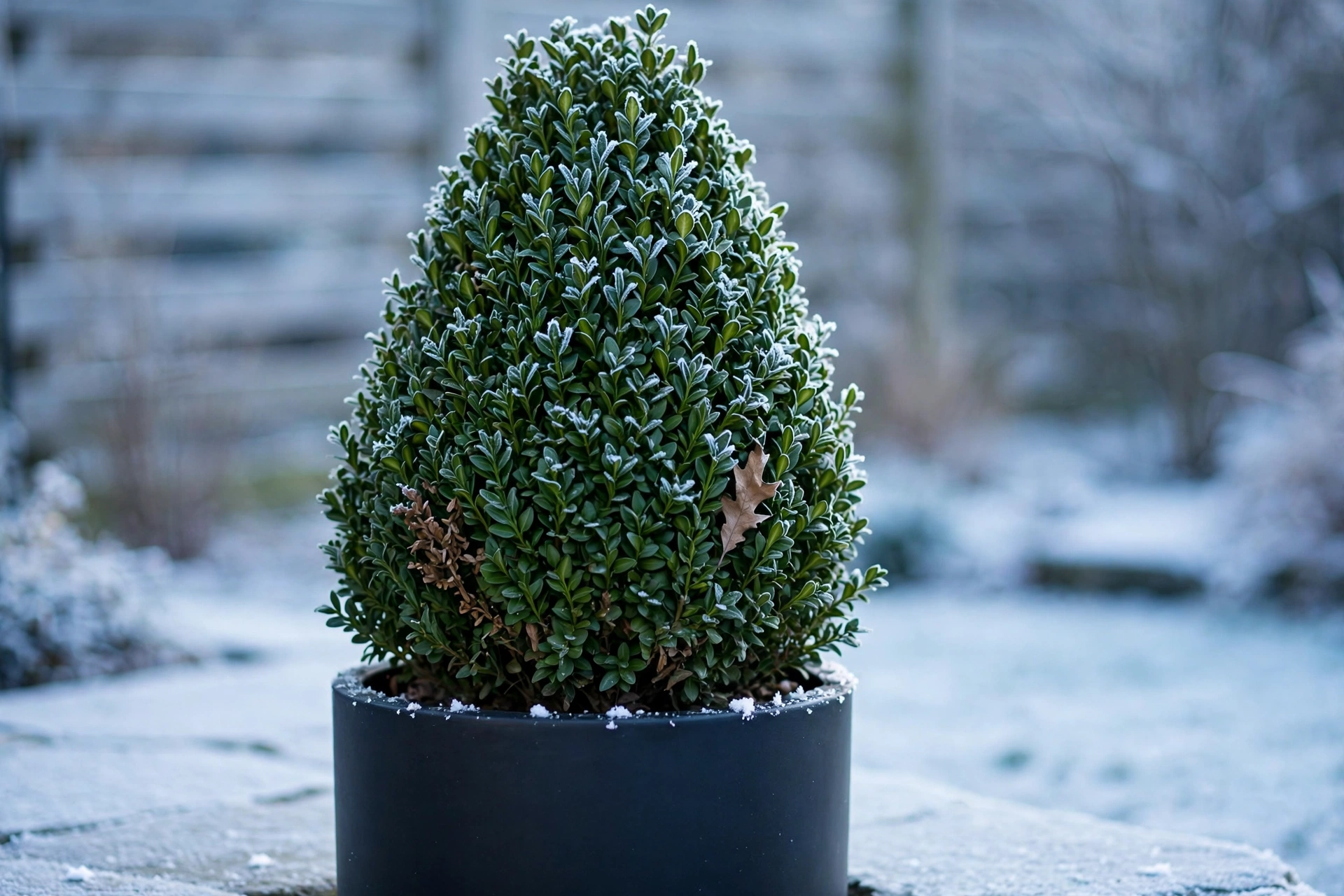
The little black dress of winter patio plants. A boxwood cone or ball in a planter looks intentional and alive from November to March, asking almost nothing. ‘Green Velvet’ and ‘Green Mountain’ are the toughest cultivars; they hold deep green color without the winter bronzing cheaper varieties get. Shear lightly in late summer — never in fall, or the tender new growth freezes.
Shop for / Search for: “‘Green Velvet’ boxwood 3 gallon for winter containers”
💡 PRO TIP — THE 2-ZONE RULE: A plant rated hardy to zone 5 in the ground is only reliably hardy to zone 7 in a pot. Roots in containers freeze from all sides, including the sides and bottom that earth would insulate. Always buy 2 zones hardier than your USDA zone — this single rule prevents 90% of winter container deaths.
2. Dwarf Alberta Spruce
Best for: The Christmas-tree look that lasts all winter | Container hardy to zone 4
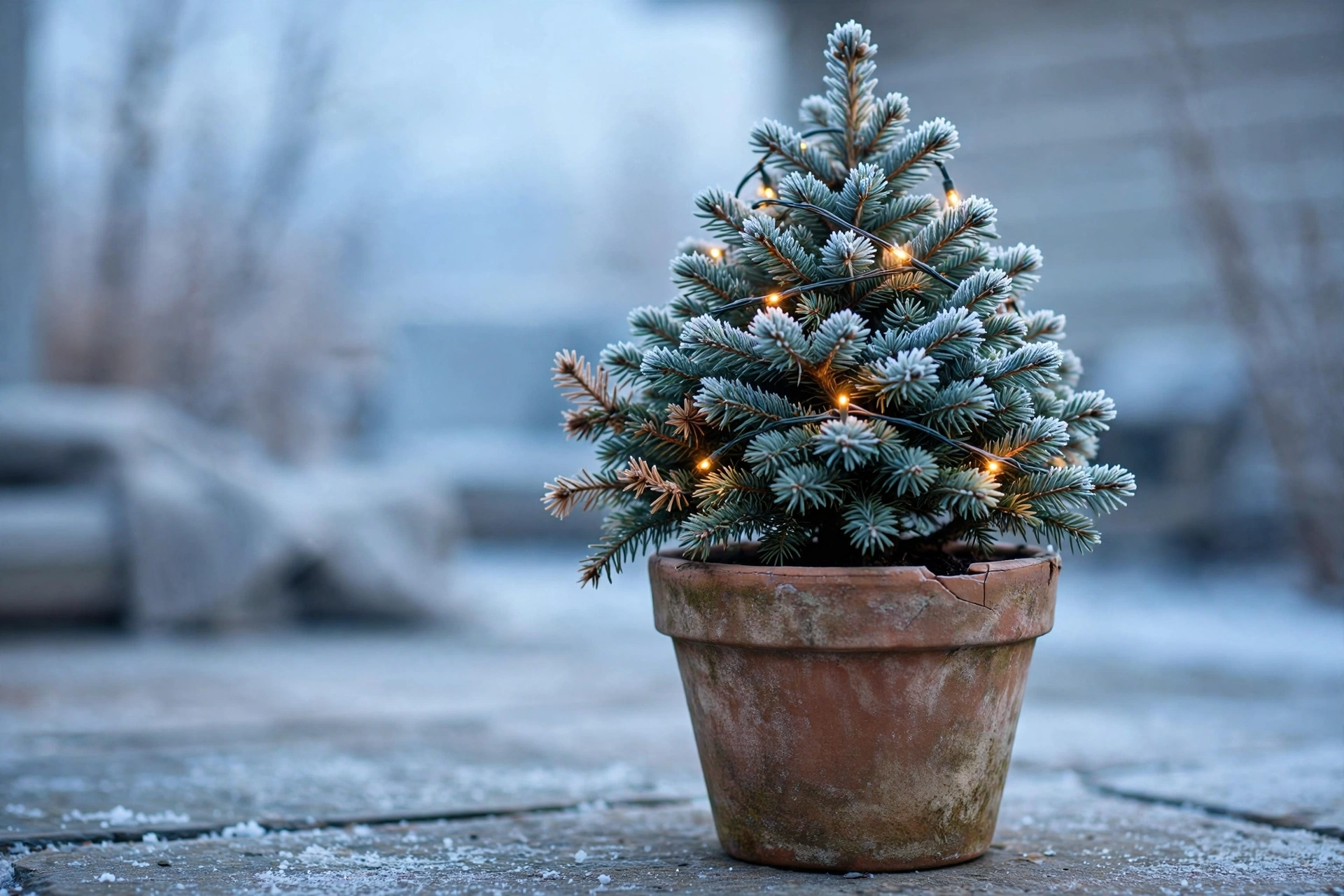
Picea glauca ‘Conica’ is the slow-growing dwarf spruce that looks like a miniature Christmas tree — dense, conical, perfect. It grows barely an inch a year, so buy the size you want. The fine needles catch frost beautifully, turning your patio into a snow globe after every cold snap. Give it morning sun and afternoon shade; winter windburn (brown needles on the windward side) is its one weakness — cluster it with other pots as a windbreak.
Shop for / Search for: “dwarf Alberta spruce 2 gallon Picea glauca Conica”
3. Hellebores (Lenten Rose)
Best for: Actual winter FLOWERS — blooms in snow | Container hardy to zone 5
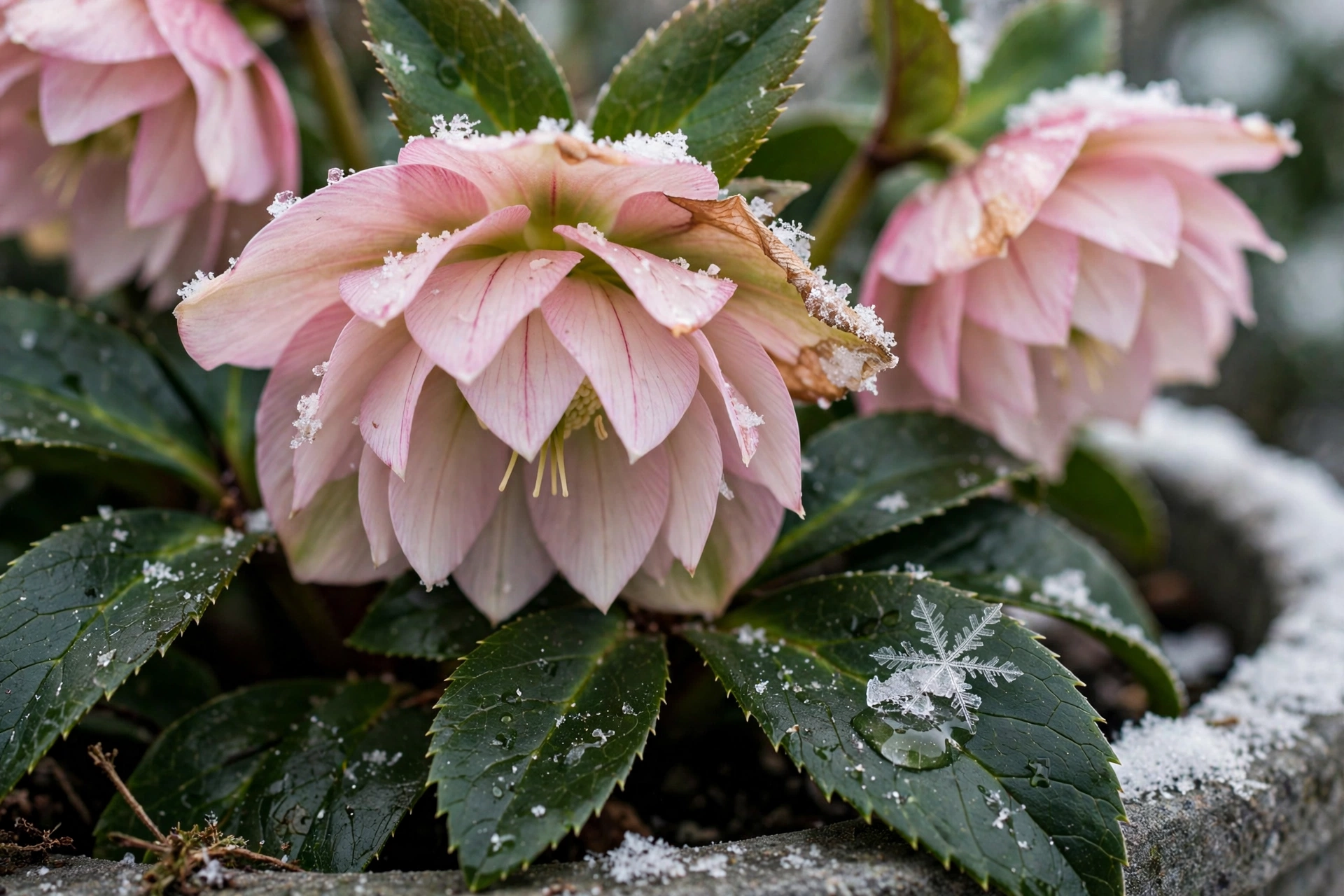
For winter patio plants that bloom, hellebores are the miracle plant. Hellebores push cup-shaped blooms in white, blush, plum, and near-black from late winter through early spring — often while snow is still on the ground. Plant them in fall so roots establish before the freeze; the leathery evergreen foliage looks good all winter even before buds open. They want shade and consistent moisture — the north side of the patio is ideal.
Shop for / Search for: “hellebore Lenten rose 1 gallon winter blooming”
4. Winter Heather (Erica carnea)
Best for: Low spreading color, bees love the early blooms | Container hardy to zone 5
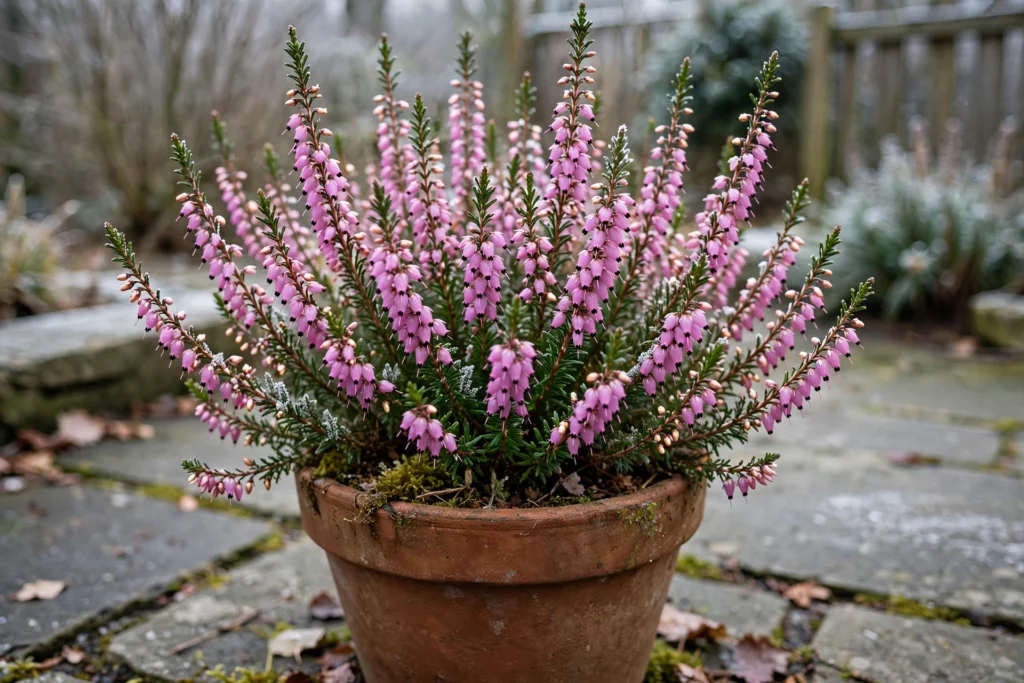
While everything else sleeps, winter heather covers itself in tiny bell flowers from January through March — pink, white, or ruby depending on cultivar. It’s a low, spreading evergreen that drapes beautifully over container edges. ‘Springwood White’ and ‘Myretoun Ruby’ are the toughest. It wants acidic soil and hates wet feet in winter, so use a bark-heavy potting mix and a pot with real drainage.
Shop for / Search for: “Erica carnea winter heather Springwood White”
💡 PRO TIP: Winter heather blooms feed the first hungry bees of late winter — plant it where you’ll see the morning sun hit it, and you’ll get a tiny wildlife show with your coffee.
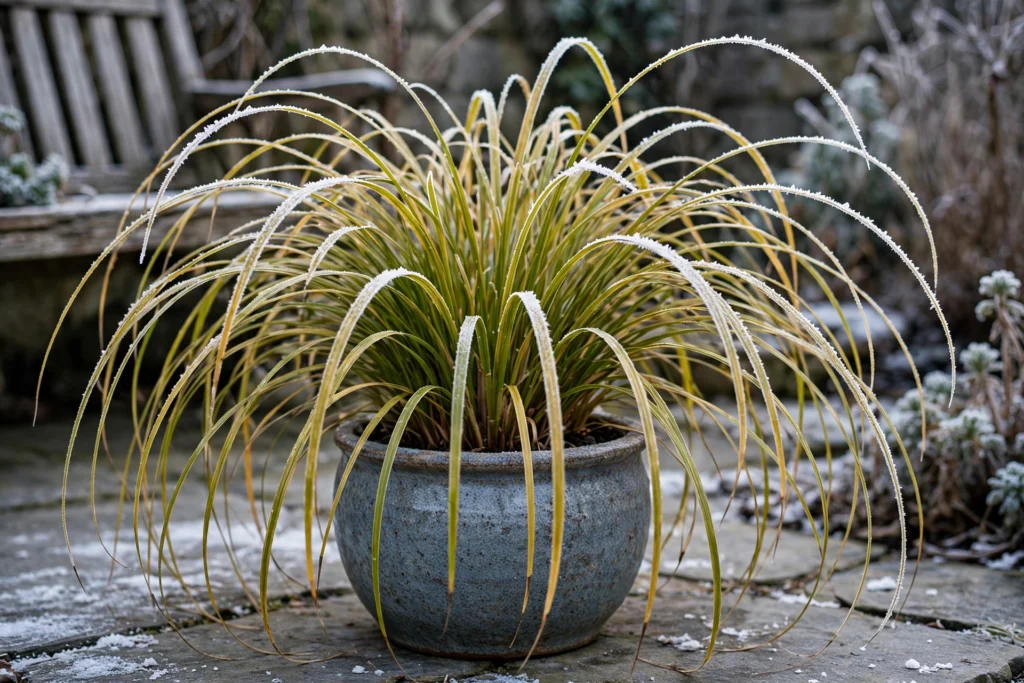
5. Ornamental Sedges (Carex)
Best for: Grass-like texture and movement in winter | Container hardy to zone 5
Carex ‘Evergold’ and ‘Ice Dance’ keep their arching striped foliage all winter — cream-and-green blades that catch low winter light like fiber optics. They don’t go dormant, don’t need cutting back until spring, and shrug off frost that kills lesser grasses. Plant three in a wide bowl for a fountain effect, or tuck one into every mixed container as the “thriller” texture.
Shop for / Search for: “Carex Evergold ornamental sedge 1 gallon”
📌 You’ll Also Love This
Cozy Fall Patio Decor
Fall is planting season for winter interest — start your cold-season patio here. →
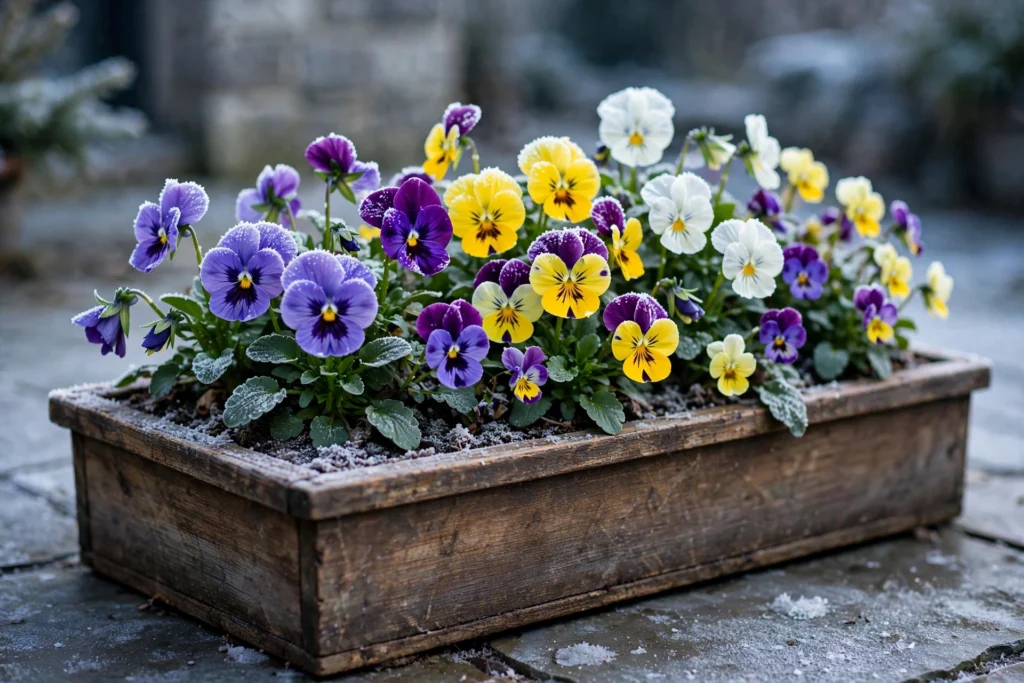
6. Pansies & Violas
Best for: Cheerful color in mild-winter zones | Container hardy to zone 6 (pansies), zone 5 (violas)
Among winter patio plants, pansies are the classic winter annual — and tougher than they look. Pansies bloom through light frosts and rebound after freezes; violas are even hardier, often flowering in zone 5 winters. In zones 7+, they’re a true winter plant; in colder zones, treat them as a fall-to-December show. Deadhead weekly and they’ll bloom until the hard freeze. The ‘Matrix’ and ‘Cool Wave’ series are bred specifically for cold performance.
Shop for / Search for: “Cool Wave pansies winter hardy trailing”
🏠 RENTER NOTE: Everything on this list is container-grown, which makes the whole post renter-perfect — every plant here moves with you. Winter is actually the ideal moving season for container plants since they’re dormant.
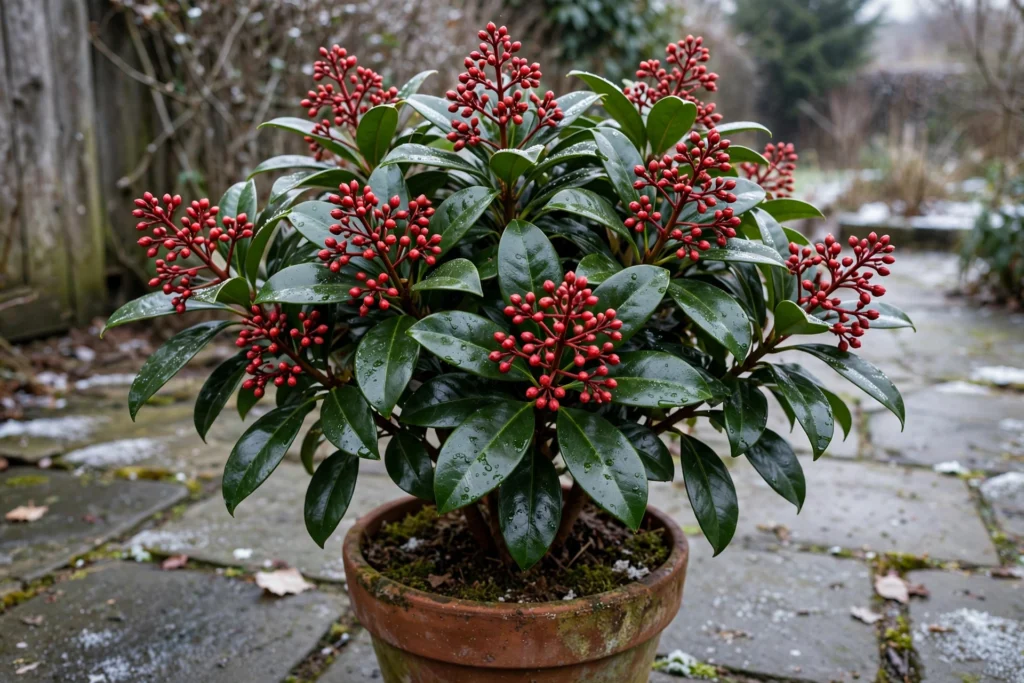
7. Skimmia Japonica
Best for: Fragrant winter blooms + red berries | Container hardy to zone 6
Skimmia is the overachiever: glossy evergreen leaves all year, fragrant white flower clusters in late winter, then bright red berries (on female plants) that persist for months. ‘Rubella’ is the standout cultivar — its red flower buds show all winter before opening white-pink in March. It wants shade and shelter from winter wind; a covered patio corner is perfect. Buy a male + female pair if you want the berries.
Shop for / Search for: “Skimmia japonica Rubella 2 gallon shade evergreen”
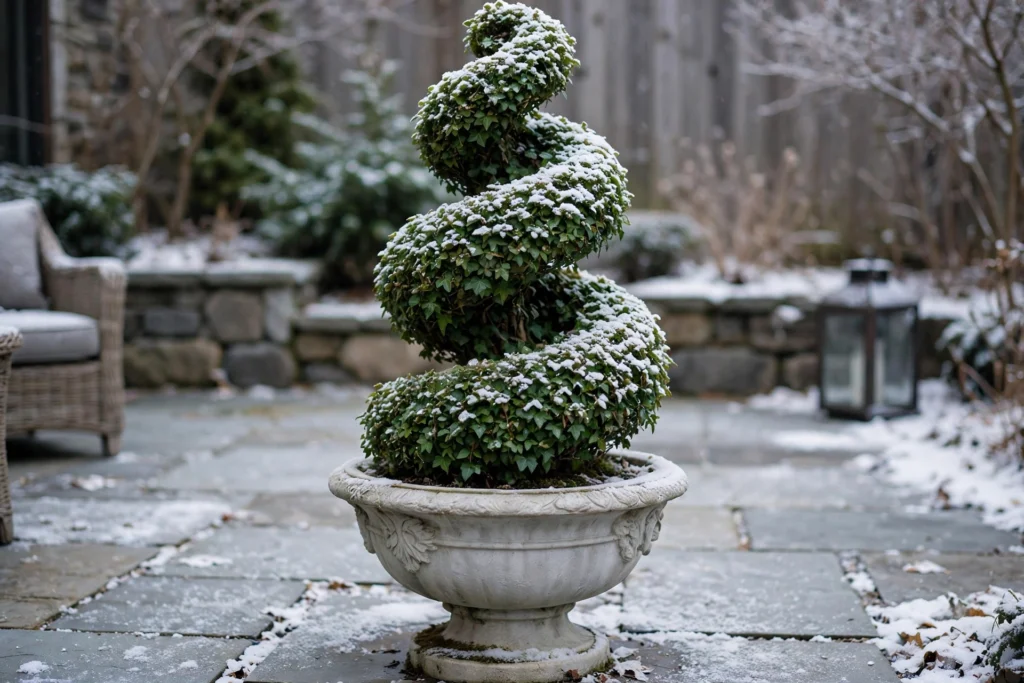
8. Ivy Topiary
Best for: Formal structure that ignores winter | Container hardy to zone 5
English ivy (Hedera helix) trained into cones, balls, or spirals gives you formal garden structure for almost no money — and it’s fully evergreen through freezes that kill fussier topiary. The variegated cultivars (‘Glacier’, ‘Gold Child’) add winter light with their cream-splashed leaves. Keep the soil barely moist; ivy hates winter wet more than winter cold. A cone topiary flanking the front door is the classic winter welcome.
Shop for / Search for: “ivy cone topiary live plant 3 foot”
💡 PRO TIP: Spin ivy topiaries a quarter-turn every month in winter — the side facing the house gets no light and thins out. Five seconds, once a month, keeps the cone full all around.
9. Red-Twig Dogwood (Cornus sericea)
Best for: Bare-stem winter drama — the best color after leaf drop | Container hardy to zone 3
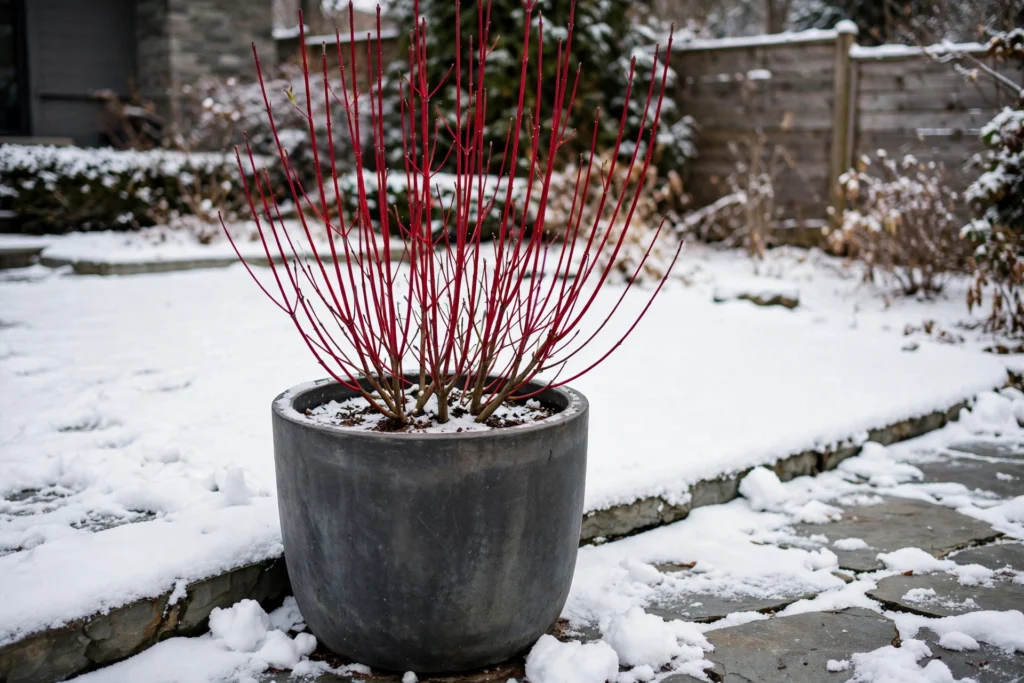
For dramatic winter patio plants, when the leaves fall, red-twig dogwood gets BETTER. The bare stems flame crimson against gray winter skies — it’s the single highest-impact winter plant in this guide. ‘Arctic Fire’ stays compact for containers. Cut a few stems in fall for tall indoor-meets-outdoor arrangements, and coppice (cut to the ground) every third spring — new stems grow back the brightest red. The stems against snow are unforgettable.
Shop for / Search for: “Cornus sericea Arctic Fire dwarf red twig dogwood”
📌 You’ll Also Love This
Budget Patio Makeover Under $200
Winter structure + a $200 refresh = a patio with year-round bones. →
Winter Patio Plants Compared
| Plant | Container hardy to | Sun | Winter interest | Water in winter |
|---|---|---|---|---|
| Boxwood | Zone 5 | Part shade | Evergreen structure | Monthly |
| Dwarf Alberta spruce | Zone 4 | Morning sun | Frost-dusted form | Monthly |
| Hellebores | Zone 5 | Shade | Blooms in snow | Biweekly |
| Winter heather | Zone 5 | Full sun | Jan–Mar flowers | Monthly (hates wet) |
| Ornamental sedge | Zone 5 | Part shade | Striped texture | Monthly |
| Pansies / violas | Zone 6 / 5 | Full sun | Cold-season color | Biweekly |
| Skimmia | Zone 6 | Shade | Buds + berries | Monthly |
| Ivy topiary | Zone 5 | Part shade | Evergreen form | Monthly (barely moist) |
| Red-twig dogwood | Zone 3 | Full sun | Crimson stems | Monthly |
Container hardiness = in-ground rating minus 2 zones (the 2-zone rule).
9 Winter Patio Plants That Actually Survive
- Buy 2 zones hardier than your area — the single rule that prevents nearly all winter container deaths.
- Cluster pots against the house — the wall radiates heat and blocks wind; it’s worth 5–10 degrees.
- Water monthly, even in winter — drought kills more potted winter plants than cold does.
- Mulch the pot tops — 2 inches of bark over the soil insulates roots from freeze-thaw cycles.
- Skip the saucers — standing water freezes, expands, and cracks both pot and roots.
- Evergreens are the backbone — structure first (boxwood, spruce, ivy), then add the bloomers.
- Don’t fertilize after August — late feeding pushes tender growth that freezes.
What winter patio plants survive in pots outside?
Boxwood, dwarf Alberta spruce, hellebores, winter heather, ornamental sedges, skimmia, ivy topiary, and red-twig dogwood all survive freezing winters in containers — provided you buy varieties rated 2 USDA zones hardier than your area (the container 2-zone rule).
Do I need to water patio plants in winter?
Yes — monthly for most evergreens, biweekly for bloomers like hellebores and pansies. Winter drought kills more container plants than cold. Water on mild afternoons when the soil isn’t frozen.
How do I protect potted plants from freezing?
Cluster pots together against the house wall, mulch the soil surface 2 inches deep, wrap extra-tender pots in burlap, and remove saucers so water can’t pool and freeze. The house wall alone buys 5–10 degrees of microclimate protection.
Can pansies survive frost in containers?
Yes — pansies bloom through light frosts and rebound after freezes; violas are even tougher. In zone 7+ they’re true winter plants; in zone 5–6, expect a fall-to-December show. The ‘Cool Wave’ series is bred for cold.
Why Trust This Guide
I’ve overwintered every plant on this list in containers on my own patio — including the winter I left them all out as an experiment and the hellebores bloomed in February snow. I track container hardiness by the 2-zone rule, not the nursery tag, because the tag describes in-ground plants and your patio isn’t the ground.
These winter patio plants prove a patio has bones in winter. Plant the evergreens for structure, add the bloomers for surprise, cluster everything against the house — and style the cold-season scene with cozy fall patio decor as your bridge from autumn.
